Chinese characters
The oldest script still in use, in which each sign stands for a word or a meaningful syllable.
1In brief
The oldest script still in use, in which each sign stands for a word or a meaningful syllable.
Type: Logographic — Many signs stand for a word or an idea, combined with sound signs. Understand types of scripts.
2History
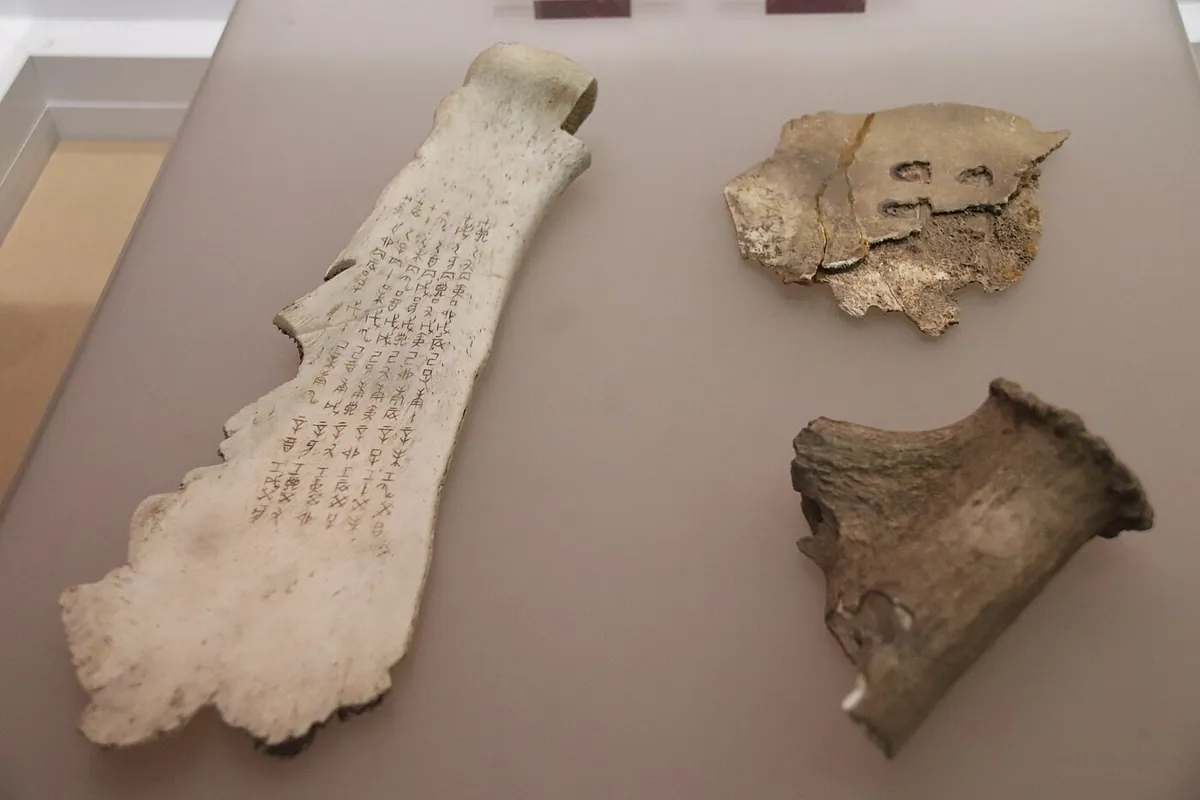
The oldest known Chinese texts were carved around 1250 BC on bones and turtle shells to question the ancestors: these are the “oracle bones”. The script has changed style since, but not its principle: each character stands for a syllable and a meaning.
A few characters are old drawings (人, a person; 山, a mountain), but most combine a radical, which hints at the meaning, and a part that hints at the pronunciation. Since the 1950s mainland China has used simplified characters; Taiwan, Hong Kong and Macau keep traditional characters. Japanese uses them too, under the name kanji.
3A word to see
4For real
5Lineage
This script has no known ancestor among the scripts shown here: it was invented locally, or its origins are still debated.
It gave rise to
6Did you know?
- A sentence written in characters can be read by Chinese people who do not speak the same language: the meaning travels through writing.
- The character 龘 (dá, the look of a dragon in flight) has 48 strokes.